
The AI Tools Worth a Real Estate Agent’s Time
A general writing assistant, a meeting transcription tool, a photo cleanup tool, and a scheduling or notes helper. Those four categories cover most of what AI can realistically do for a real estate agent right now. The tools are free or cheap. Everyone has them. What separates the agents using them well from the ones just saying they use AI is the quality of their inputs.
Gary Vaynerchuk gave the same piece of advice to social media marketers in 2008 that applies to AI today: the platform is not your edge. The edge is what you put into it.
Back then, every business owner had access to YouTube and Twitter. Very few used either well. Today, every agent has access to a general AI assistant. Very few use it well. The tool is the same. The gap is the operator.
This piece organizes what AI can actually do for a real estate agent by job, not by brand. Specific products change names, pricing, and ownership fast enough that any brand list is stale before the article ranks. What does not change is the category of work you are trying to get done.
If you want a deeper look at how this fits into a broader content and referral strategy, the AI for realtors guide at forward.loans/ goes further on the business side.
The four categories worth your time
These are not the only AI tools on the market. They are the ones where the time savings are real and the learning curve is short enough that a busy agent can actually build a habit around them.
| Category | Job to be done | Time saved per week |
|---|---|---|
| General writing assistant | First drafts of emails, listing descriptions, follow-up sequences | 2 to 4 hours |
| Meeting transcription tool | Notes from buyer consults, listing appointments, calls | 1 to 2 hours |
| Image cleanup tool | Quick photo edits for listings within MLS rules | 30 to 60 minutes |
| Scheduling or notes helper | Calendar drafts, reminders, follow-up tracking | 30 to 60 minutes |
The time estimates are rough and depend entirely on how you input the work. That part matters more than the tool choice.
The general writing assistant
This is where most agents start, and where most of them stop improving. They type a vague prompt, get a vague result, paste it, and wonder why it sounds like a press release from a company no one has heard of.
A general writing assistant (any of the major chat-based AI tools) is only as good as what you give it. Treat it like a new hire who writes well but knows nothing about you, your client, or the neighborhood. Brief it the same way you would brief a person.
Instead of: “Write a listing description for a 3-bed 2-bath in Scottsdale.”
Try: “I am a Scottsdale listing agent. This home is a 3-bed 2-bath in McCormick Ranch, updated kitchen, original bathrooms, vaulted ceilings. Write a 120-word MLS description that leads with the kitchen and closes on the neighborhood access to the loop trail system. No exclamation points. No words like ‘stunning’ or ‘gorgeous.'”
The second prompt gets a usable draft in one pass. The first prompt gets you something you will rewrite from scratch.
Forward Loans
What do you want help with?
Forward Loans NMLS #2006640. Michael Creel NMLS #420674.
The meeting transcription tool
A buyer consult is 45 minutes of notes you will either not take, take badly, or take so thoroughly that you miss the conversation. A transcription tool records the call or meeting, produces a transcript, and lets you ask it to pull the action items, the objections, and the follow-up promises you made.
The privacy piece matters here more than with any other category. Before you record a client meeting, check your state law on consent. Arizona is a one-party consent state, but if your buyer is in a two-party consent state, you need to tell them. Tell them anyway as a habit. Most clients do not care. A few will appreciate that you take notes seriously enough to use a system.
What changes when you use this well: your follow-up emails are specific because they reference what the client actually said. "You mentioned the home office was non-negotiable" lands differently than "as we discussed."
The image cleanup tool
This one has a limit most agents do not talk about: the MLS rules.
AI photo tools can remove a car from a driveway, brighten a dark room, and fix a blown-out sky in under a minute. Some of them can also remove the neighbor's trash cans, repaint the exterior, and replace the dead grass with a lawn that does not exist. That last group crosses into misrepresentation.
The rule of thumb most agents use: if you could fix it with a weekend's work and it would look like the photo when you did, the edit is defensible. If the AI is inventing something that is not there and will not be there by closing, you have a disclosure problem.
Check your MLS rules directly. Many now have explicit AI disclosure requirements. Knowing them before your listing goes live is easier than explaining them to a buyer after.
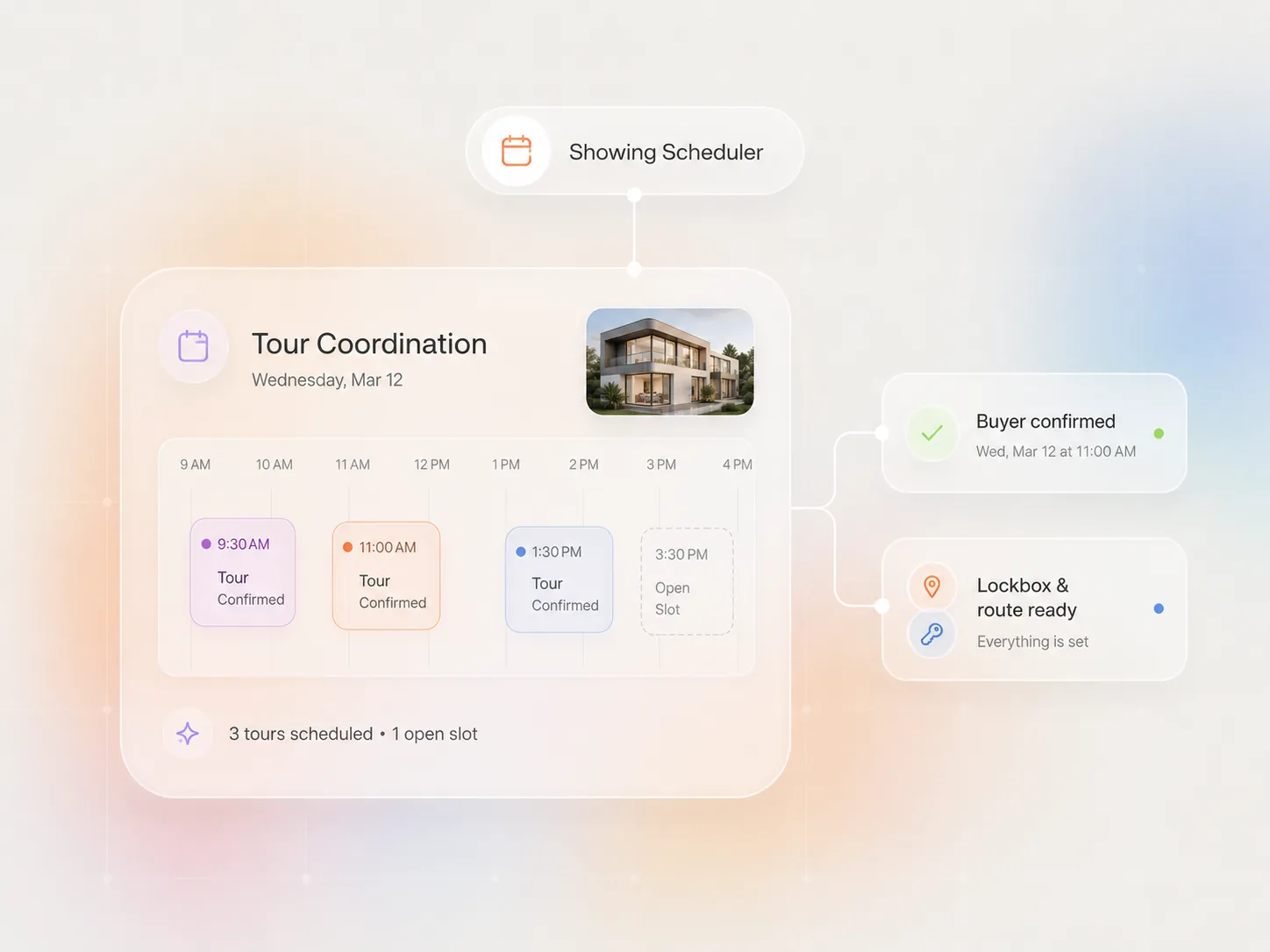
The scheduling and notes helper
Lower drama than the others. Higher daily use.
A good scheduling or notes tool catches the things that fall between your CRM and your phone. Draft a follow-up reminder from a voice memo. Turn a scattered list of open house to-dos into a sequence with deadlines. Write a first draft of a drip email campaign based on a client's timeline you described in plain language.
Where agents waste time here is in setup. They spend three hours configuring workflows that would have taken six minutes to do manually. Set up the one workflow you will actually repeat ten times a month. Leave the rest alone until you know you need it.
How to decide if a tool earns a place in your week
Three questions, and they need honest answers:
- Does it save you real time, or does it just feel productive? If you spend 20 minutes setting up a task that would have taken 10 minutes to do, the tool is not saving you time. It is borrowing it.
- Does it fit how you already work? A transcription tool only helps if you are already doing buyer consults on a platform it can access. A writing assistant only helps if you write things regularly. The best tool is the one you will actually open.
- Is your client data safe in it? Do not put a client's full name, address, and financial situation into a free AI tool with default privacy settings. Read the privacy policy for any tool that touches client information. If it says your inputs train the model, your client's data is being used to train a model. That is a conversation to have with your broker before it happens, not after.
The one thing the tools cannot do
There is a flood of AI-written listing descriptions, AI-written market updates, and AI-written follow-up emails hitting inboxes and social feeds right now. Most of them read the same. That is the ceiling when the tool is the whole strategy.
The agents who cut through are not using different tools. They are putting sharper inputs in. The description that starts with a real detail you noticed walking the property did not come from a prompt template. It came from an agent who paid attention during the consult and then used AI to help write what they already knew.
Worry about the inputs. The outputs take care of themselves.
Frequently asked questions
What AI tools do most real estate agents use?
Most agents who actively use AI are working with a general chat assistant for writing and a transcription tool for calls and meetings. Image cleanup tools have grown fast with listing agents in the last year. Scheduling helpers are common but often underused. The category matters more than the specific brand, since the leading products in each category shift regularly.
Is it safe to put client information into an AI tool?
It depends on the tool and its privacy settings. Some tools use your inputs to train their models by default. Others offer a privacy mode or business tier that keeps your data out of training sets. Check the privacy policy before putting any client name, address, or financial detail into a tool. When in doubt, describe the situation without identifying the client.
Can AI write my listing descriptions for me?
It can write a first draft. How good that draft is depends on how specific your prompt is. Give the tool the home's features, the buyer profile, the neighborhood angle, and your word count. You still need to read it, edit it, and make sure it matches the property. AI-written descriptions that go straight to MLS without a human pass tend to sound like every other AI-written description.
Do MLS rules allow AI-edited listing photos?
Most MLS systems have rules about virtual staging and photo editing, and many are now adding specific language about AI edits. The general principle is that photos must represent the property accurately. Removing a car from the driveway is different from replacing dead grass with a green lawn. Check your local MLS rules directly and when anything is uncertain, disclose.
How much time can AI actually save a real estate agent?
Agents who use a writing assistant and a transcription tool consistently report saving two to six hours a week on administrative writing tasks. The number varies by how much you write, how many calls you take, and how well you prompt the tools. The savings compound once you stop rewriting bad AI drafts and start giving better instructions upfront.
What is the biggest mistake agents make with AI tools?
Collecting tools they do not use. An agent with five AI subscriptions and two active habits is paying for three tools that sit idle. Pick one category, build a real habit around it for 30 days, then add the next. A writing assistant you use every day beats a full AI stack you touch twice a month.
Pick one category, build a habit around it, and add the next only when the first one sticks. The tool is not the edge. You are.